
CNC SERVICES
CNC MILLING
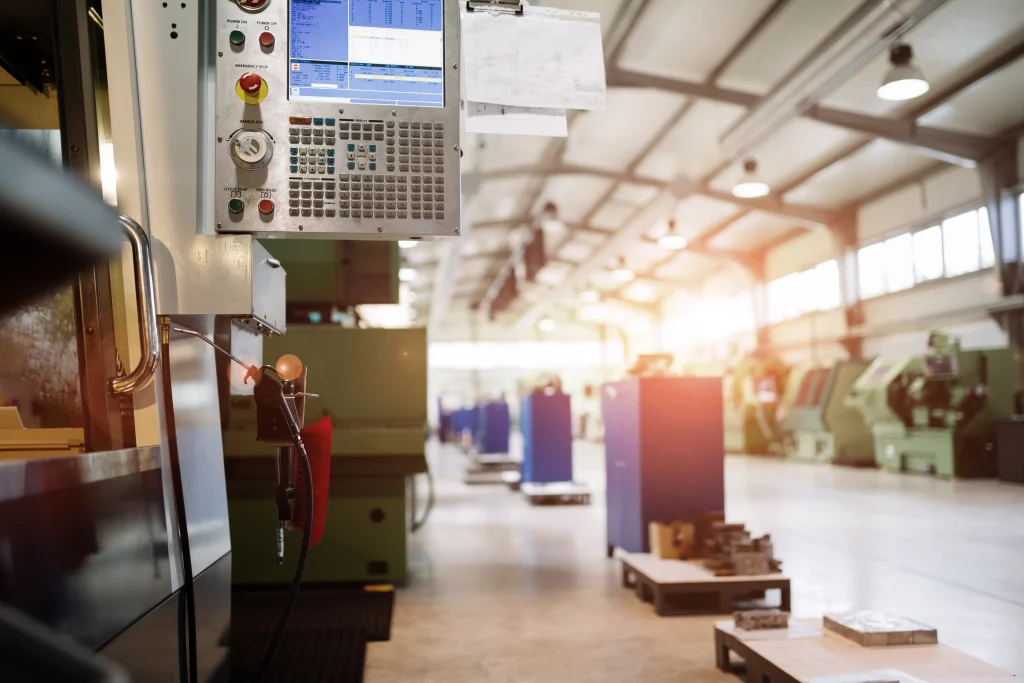
CNC milling is an advanced machining process in which computer-controlled milling machines remove material from an object, creating precise details according to a programmed design.
Our company offers CNC milling services, using state-of-the-art technology to provide our customers with high quality, repeatable and accurate workmanship.
Our CNC machines allow us to process a wide variety of materials, from metals to plastics, making it possible to complete even the most complex projects. In addition, using our services, our customers can count on professional technical advice at every stage of the process.
CNC TURNING
We perform our services based on the documentation provided by the customer, carrying out both standard and more complex orders. Our state-of-the-art machinery allows us to perform a variety of work, including CNC turning, external and contour turning, grooving, drilling, cutting, face machining and threading.
Thanks to the wide range of our services, we are able to meet expectations by providing precise and timely execution of orders.
We carry out work on both our own and customer-supplied materials, covering ferrous metals, non-ferrous metals, stainless steels, plastics and many other types of materials.
Our specialists are ready to help you find the optimal solution, tailored to your individual needs.
CONVENTIONAL TURNING
Conventional turning is used for machining the internal and external surfaces of certain components. It is a form of machining that involves removing excess material from the workpiece under development.
Conventional turning can be used to machine a variety of materials, including plastics, nonferrous metals and steel. Our company specializes in conventional turning, with experienced specialists and expertise in operating manual lathes.
We offer comprehensive conventional turning services for industry and companies in various sectors. Conventional turning is effective because of its speed of execution, competitive price and the possibility of quick correction.
We recommend conventional turning for:
– Machining of all kinds of prototype parts,
– Realization of small orders,
– Orders requiring quick turnaround time.
In our work we use high-quality materials from reliable suppliers, which in combined with a professionally conducted service guarantees the delivery of products with desired parameters and high quality.
SHAFT GRINDING
Grinding is a type of machining that aims to achieve a high degree of surface smoothness with minor geometry correction. Such treatment of drive parts makes the operation of the entire system improved, and in the future it is much less prone to failures and serious malfunctions.
Shaft grinding is a machining process that aims to:
- Removing irregularities and contaminants from the surface of the shaft.
- Achieve precise dimensions within tolerances as small as a few microns
- Improve surface roughness which provides better lubrication and reduced friction.
Shaft grinding is used in various industries, including:
- Automotive – for regeneration of crankshafts in internal combustion engines.
- Machinery – for regeneration of drive shafts, working shafts and other machine components.
- Heavy industry – for regeneration of shafts of rolling mills, presses and other high-powered machines.
Types of shaft grinding:
- Cylindrical grinding – used for machining the outer surfaces of shafts of circular cross-section.
- Frontal grinding – used for machining the faces of shafts.
- Multiple grinding – used for machining shafts with complex shapes.
Advantages of shaft grinding:
- Restoring the efficiency of the shaft and extending its service life.
- Increasing machine safety and reliability.
- Reduction of machine operating costs.
- Possibility of regenerating shafts instead of replacing them with new ones.
SURFACE GRINDING
Surface grinding is a machining process that uses grinders to precisely remove material from flat surfaces.
Objectives of surface grinding:
- Surface leveling: Grinding removes irregularities and contaminants to provide a perfectly flat surface.
- Improving roughness: A smooth surface after grinding provides better lubrication and reduced friction, resulting in longer component life.
- Accurate sizing: we achieve dimensions within tolerances as small as a few microns
- Regeneration of worn parts: Grinding can restore the original geometry and functionality of worn parts.
Applications of surface grinding::
- Automotive: machining of engine heads and blocks, cylinders, pistons, connecting rods and other components.
- Machinery: Machining of guides, work tables, bearings and other machine components.
- Tool rooms: Machining tool plates and other tools.
Advantages of surface grinding:
- High precision and accuracy of machining.
- Repeatability of the process guarantees consistency of results.
- High productivity and short machining time.
Additional information:
-Different types of grinding wheels are used for CNC surface grinding, including alumina grinding wheels, diamond grinding wheels, and ceramic grinding wheels.
-Grinding parameters, such as cutting speed, feed rate and grinding force, are selected according to the type of workpiece material, required accuracy and other factors.